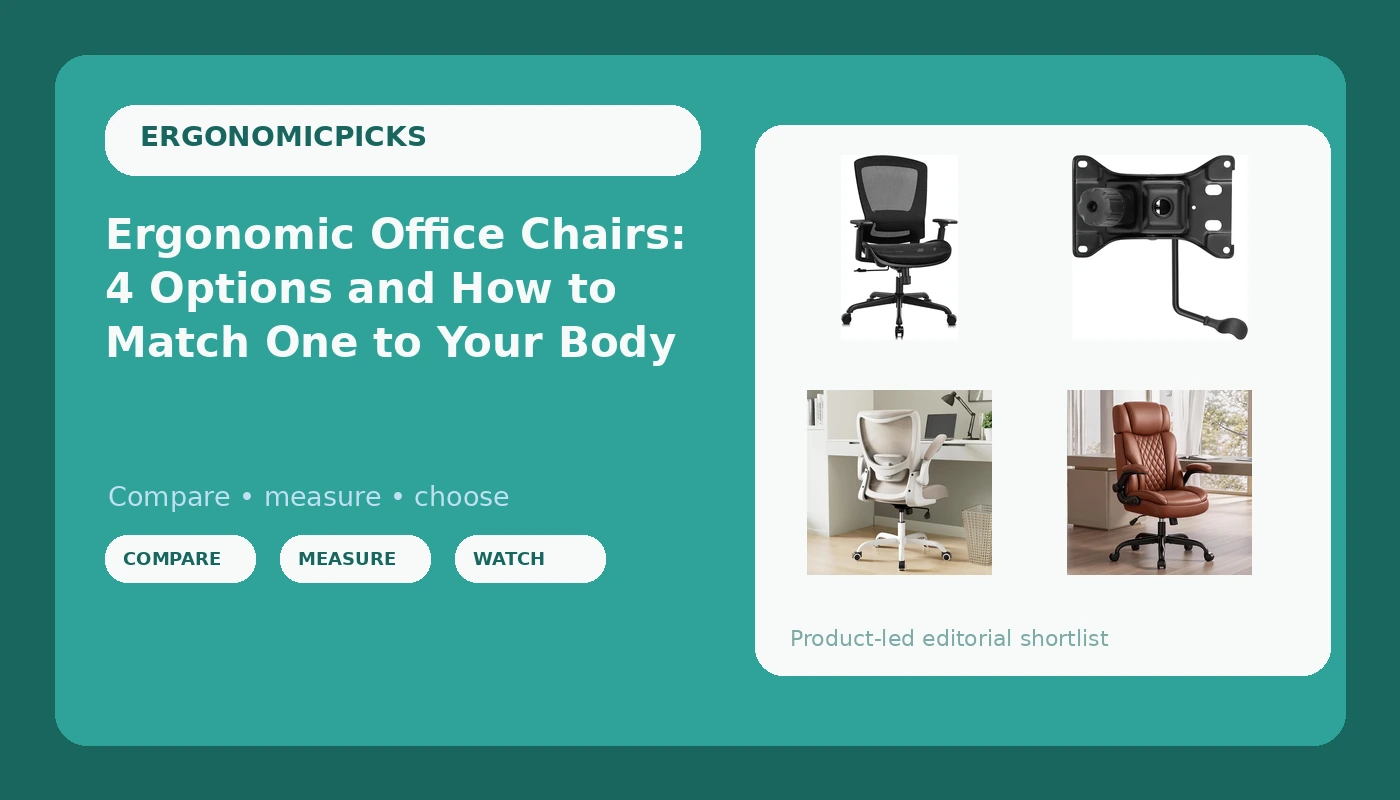
Ergonomic office chairs are one of the few pieces of furniture you are asked to buy on faith. You sit in one for four minutes in a showroom, or you read a listing that promises "adjustable lumbar support," and then you spend eight hours a day finding out whether that promise holds. Most chairs that fail do not fail loudly. They fail quietly. The lumbar pad slides down by mid-afternoon, the armrests drift outward, the seat runs two inches too deep so the front edge digs into the back of your knees, and by month fourteen the gas lift has given up. The four products below are not variations on one idea. They cover four different jobs: a fully adjustable task chair, a lighter mesh chair with armrests that move out of the way, a cushioned executive chair built for reclined sitting, and a replacement mechanism for the chair you already own.
Related: How to Set Up Lumbar Support at Your Desk →
Quick answer
No single chair fits every body, so the honest answer is to match the adjustment set to your height, your seat depth, and how you actually sit. For a full-time desk job where you want lumbar and armrests that adjust in place, look at the ELABEST mesh task chair first. For a smaller home office where the chair gets pushed under a desk, the MUXX.STIL chair with flip-up armrests is the more practical shape. For reclined, cushioned seating rather than upright task posture, the executive chair is the right category. And if the chair you own is fine except for a dead tilt mechanism, the Besitu replacement part is the cheapest path back to a working chair.
4 useful options
| Model | Best fit | What stands out |
|---|---|---|
| ELABEST Ergonomic Mesh Office Chair | Full-day desk work that needs adjustable lumbar and armrests | BIFMA 5.1 certified commercial swivel task chair with tilt function and a wide seat |
| MUXX.STIL Office Chair | Small home offices where the chair slides under a desk | Adjustable lumbar support and armrests that flip up |
| Executive Office Chair | Reclined, cushioned seating in a home office | Executive styling in an ergonomic computer chair build |
| Besitu 500Lbs Chair Mechanism | Repairing or upgrading a chair you already own | Heavy duty tilt control mechanism with 6 inch by 10.2 inch mounting holes |
The adjustable task chair: ELABEST Ergonomic Mesh Office Chair
This is the option to look at when you need the adjustment set rather than a single feature. The distinction that matters here is not that it is mesh, because plenty of cheap chairs are mesh. It is that the lumbar support and the armrests are both listed as adjustable, and the chair carries a BIFMA 5.1 commercial certification, which is a durability and safety standard rather than a comfort claim. Tilt function means the whole seat and back move together when you lean, which is a different motion than a back that flexes on its own. The trade-off is straightforward: a commercial task chair is heavier, it looks like office equipment rather than living room furniture, and it asks more of your budget than a basic mesh chair. If you sit upright for six or more hours a day and your shoulders round forward, this is the category that gives you something to adjust.
The light mesh option: MUXX.STIL Office Chair
Flip-up armrests are a small feature that solves a real problem. If your desk is shallow or your room is small, the chair has to slide under the desk when you are done, and fixed armrests stop it dead. The MUXX.STIL keeps the two adjustments that most affect posture, lumbar support and armrest height, while dropping the weight and the price of a commercial task chair. The khaki mesh also reads less like office furniture, which matters if the chair lives in a bedroom or a shared living space. What you give up is the heavier build and the commercial certification of the ELABEST, and flip-up armrests are inherently a simpler mechanism than a fully adjustable arm pad. If you sit four to five hours a day rather than nine, that trade is usually worth taking.
The cushioned executive option: Executive Office Chair
Upright task posture is not the only way to sit, and not everyone wants it. An executive chair is built around a padded back and a deeper recline, which suits people who lean back to read, take calls, or work from a laptop on a lap desk. The padding distributes pressure differently than mesh, and for some people that is more comfortable across a long afternoon. The trade-off runs the other way too: upholstery holds heat in a way that breathable mesh does not, deep padding can encourage a slouch if the back does not hold you, and an executive chair takes up more visual and physical space than a task chair. Buy it because you want a cushioned, reclined seat, not because you are hoping it will behave like an adjustable task chair. It will not.
The repair part: Besitu 500Lbs Chair Mechanism
This is not a chair, and it is worth being explicit about that. It is a replacement seat plate, the metal assembly that sits between the chair's seat and its gas lift and carries the swivel and tilt controls. When a chair's tilt lock stops engaging, when the swivel grinds, or when a heavier sitter has cracked the original plate, replacing this part can return a structurally sound chair to service for far less than a new chair. The catch is compatibility. The mounting holes here measure 6 inches by 10.2 inches, and they must line up with the holes in your chair's seat pan. Measure your existing plate before ordering, because a mechanism that does not match the bolt pattern is unusable no matter how heavy duty it is. The 500 lb rating also makes it a reasonable choice for larger sitters whose original mechanism was the weak link.
Prices and availability may change. Product images, names, and retailer links must be matched by verified ASIN. Do not state a current price, rating, stock status, or measured result without current evidence.
Why the word ergonomic tells you almost nothing
The label "ergonomic" on a chair listing is not a standard, a certification, or a measurement. It is a marketing word, and it appears on chairs with zero lumbar adjustment and on chairs with a genuinely adjustable lumbar mechanism, often at similar prices. That is why the useful question is never "is this chair ergonomic," but "what does this chair let me change, and does the change hold?"
There are four adjustments that actually matter for a seated workday. Lumbar support height and depth, because the inward curve of your lower back sits at a different height on a 5 foot 2 inch body than on a 6 foot 2 inch body. Seat height, so your feet rest flat and your knees sit roughly level with your hips. Seat depth, so the front edge of the seat does not press into the back of your knees and your thighs are supported along their length. And armrest position, so your elbows can rest close to your sides instead of floating. A chair that adjusts all four can be fit to most bodies. A chair that adjusts none of them is a waiting room chair with a nicer photo.
The word "adjustable" also deserves scrutiny. A lumbar pad that slides on a track is different from one that locks at a height. An armrest that moves up and down is different from one that also moves in and out. Both are marketed as adjustable. Only one of them stays where you put it at 2 PM on a Tuesday, which is the only test that matters for a chair you sit in every day.
Seat depth, tilt tension, and the parts that wear out first
Three things decide whether a chair survives year three. The first is seat depth, and it is the most commonly ignored measurement. Too deep and the front edge compresses the back of your thighs and pushes you forward into a slouch. Too short and your thighs take the load instead of the seat. The rule of thumb is to leave two to three fingers of space between the back of your knee and the seat edge.
The second is tilt tension, the resistance you feel when you lean back. A chair with loose tension lets you drift into a slouch all afternoon. A chair locked fully upright gets uncomfortable within an hour and you start fidgeting. You want a tilt that holds you up while still moving with you, which is why a seat and back that tilt together tends to feel more stable than a back that flexes alone.
The third is the mechanism itself. Gas lifts, tilt plates, and swivel bases are the parts that fail, and they fail before the upholstery does. That is why a replacement seat mechanism is a legitimate purchase rather than a compromise. If the frame and the seat pan are sound, the mechanism is the cheapest thing to renew.
- Measure your popliteal height, from the floor to the crease behind your knee, and compare it with the chair's seat height range.
- Sit with your back against the backrest and check whether the lumbar support lands in the small of your back, not your mid-back.
- Slide two or three fingers behind your knee. If they do not fit between your leg and the seat edge, the seat is too deep.
- Lean back slowly and feel where the tilt catches you. If you have to hold yourself up, the tension is too loose.
- Rest your forearms on the armrests at your keyboard. If your shoulders lift to reach them, the armrests are too high.
What to check before you buy
- Measure your desk clearance if you want the chair to slide under it, and note whether the armrests need to flip up or come off.
- Confirm the seat height range covers your popliteal height with your feet flat on the floor.
- Check whether lumbar support is listed as adjustable, and whether the adjustment is a lock or just a slide.
- For a replacement mechanism, measure the mounting hole spacing on your existing seat plate before ordering.
- Decide whether you actually sit upright or reclined. The two postures lead to different chair categories.
- Treat any chair with no lumbar adjustment as a short-term seat, not a five-year purchase.
Which option should you choose?
Choose the ELABEST Ergonomic Mesh Office Chair when you sit upright for most of the day and need lumbar support, armrests, and tilt that you can all set and forget. Choose the MUXX.STIL Office Chair when your workspace is small, the chair has to tuck under a desk, and four or five hours a day is your normal sitting load. Choose the Executive Office Chair when you want a padded, reclined seat for reading, calls, and laptop work rather than upright task posture. Choose the Besitu 500Lbs Chair Mechanism when the chair you own is structurally fine and only the swivel and tilt plate has failed.
One caveat applies to all four: fit is individual, and no listing can tell you whether a lumbar pad lands in the right spot on your spine. The adjustment set tells you what is possible. Your own measurements tell you whether it will work. Buy from a seller with a return window, sit in the chair for a full workday, and judge it on hour six rather than minute six.
The bottom line
The chair that helps you is the one whose adjustments match your body, not the one with the longest feature list or the highest price. Start by measuring your seat height and seat depth needs, then decide whether you sit upright or reclined, then choose the category that fits. If your current chair is sound except for a dead mechanism, replacing the seat plate is the least expensive fix available and keeps a working chair out of the landfill. Whatever you pick, give it a full week before you decide, because the first hour of any new chair feels fine and the sixth hour is the honest review.